By Alex Stone10 min readLast fact-checked June 2026
Jump to a section6 sections
A 30-hour study plan for CLEP Western Civilization I allocates 10 hours to the medieval era (where most readers feel weakest), 10 hours split across ancient, Roman, and Renaissance/Reformation, 6 hours to foundation reading, and 4 hours to a practice exam plus weak-area drill. Most prep guides treat the four eras equally; readers do not arrive with equal preparation, and front-loading the medieval bucket is the single biggest leverage point in this plan.
For the broader context on this exam, see the Flying Prep CLEP Western Civilization I plan. For era-specific deep dives, see the CLEP Western Civilization I medieval Europe guide and the CLEP Western Civilization I Roman Empire guide. If deciding between CLEP and AP, see CLEP Western Civilization I vs AP European History.
Why the medieval era gets the most time
The CLEP Western Civilization I exam covers roughly 4,000 years from the ancient Near East through the Peace of Westphalia in 1648, and the College Board content outline splits coverage into four eras of roughly equal weight: ancient, Roman, medieval, and Renaissance/Reformation. The exam is balanced. Most readers are not.
When I took this exam for my degree at Thomas Edison State University, where it filled the HIS 101 slot, the medieval questions were the ones I had to work hardest on at the test center. Greek philosophy and Roman emperors had been drilled into me through years of high school and undergraduate exposure; the Carolingian renaissance, the Investiture Controversy, and the structural mechanics of feudalism were thinner ground. That gap is not unusual.
Three reasons most students under-prepare on the medieval era:
- High school world history rushes the millennium between Rome's fall and the Italian Renaissance. A typical survey course gives Greece and Rome roughly six weeks combined, the Renaissance and Reformation another three, and the entire medieval period (500 to 1450) somewhere between one and two weeks. The CLEP does not mirror those proportions. It tests roughly 25 percent medieval content, on par with each of the other three eras.
- Medieval vocabulary is dense and unfamiliar. Manor, fief, vassal, scutage, simony, lay investiture, mendicant orders, Cluniac reform, Gregorian reform, Hanseatic League. None of these terms appear in everyday English the way "republic" or "democracy" do. The exam tests recognition of these terms, which means readers either know them or they do not.
- The era's geography is unstable. Borders, kingdoms, and dynasties shift across the millennium in ways that ancient Greece or Renaissance Italy do not. The Frankish kingdoms divide, the Holy Roman Empire emerges, the Crusader states rise and fall, and the late medieval period sees the consolidation of England, France, and Spain as recognizable nation-states. Tracking this requires connected study, not isolated facts.
The 30-hour plan below corrects for these by giving the medieval era a third of the total study time and treating the other three eras as parallel review blocks.
The plan: 30 hours over 12 days
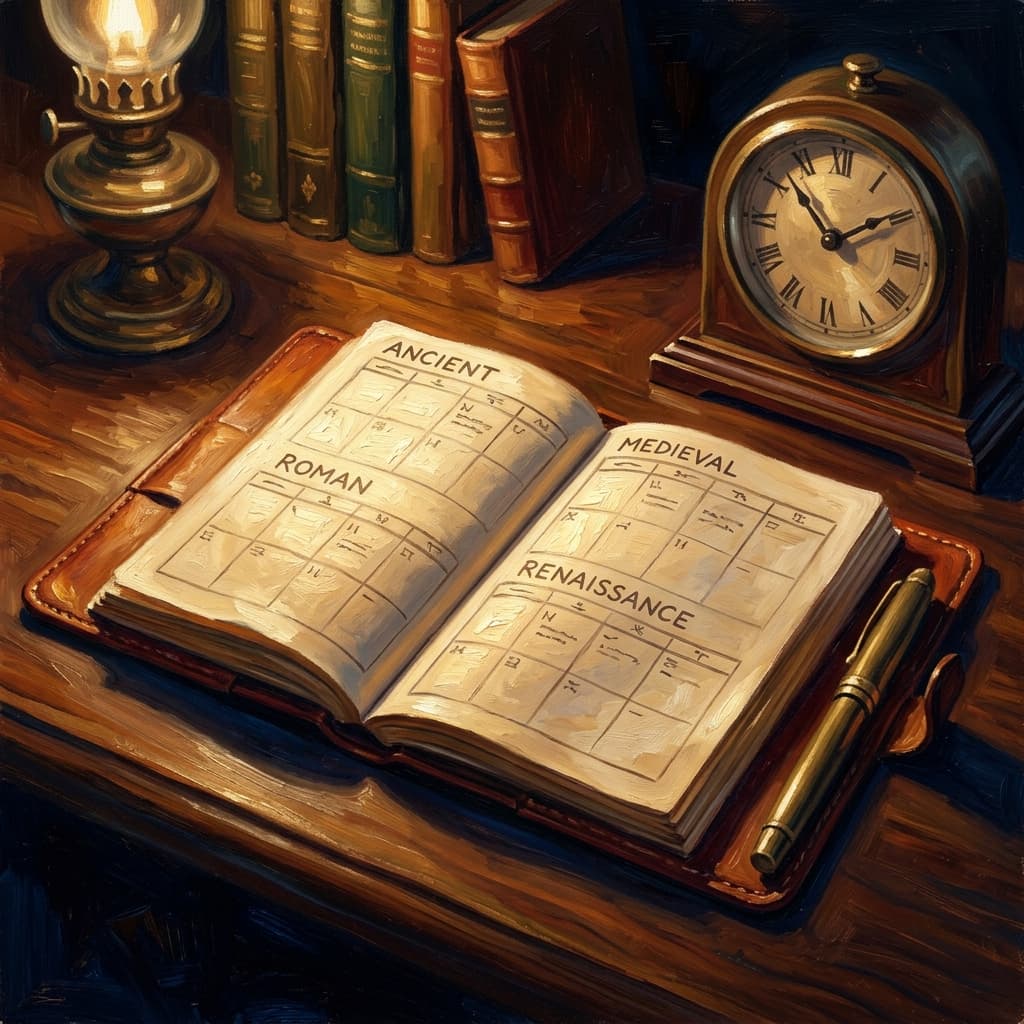
Days 1 to 3: Foundation reading (6 hours)
Read or skim a single Western civilization survey covering antiquity through 1648. Pick one source and commit; do not switch between textbooks mid-prep.
Recommended:
- OpenStax World History Volume 1 (free PDF). Strong coverage of antiquity through the medieval period, including non-Western context where it intersects with European history.
- Spielvogel's Western Civilization (textbook, used $25 to $40). The standard college-survey text most prep guides reference. The first half of the combined volume covers exactly the CLEP Western Civ I scope.
- McKay's A History of Western Society (textbook, used $25 to $40). More socially and economically contextualized; good for cause-and-effect understanding of feudalism, urbanization, and the Reformation.
What to do during foundation reading:
- Read chapter introductions and conclusions in full
- Skim chapter bodies for named figures, named treaties, named institutions
- Note the chapter timelines (most survey texts include them)
- Do not take detailed notes yet; the era-specific drill phases below will return to the textbook
End of foundation reading: you should have a mental scaffold of the four eras and roughly know the sequence of the medieval era's major turning points (fall of Rome, Charlemagne, Viking and Magyar invasions, the High Middle Ages, the Black Death, the Hundred Years' War).
Days 4 to 7: Medieval era drill (10 hours)
Two and a half hours per medieval sub-era. The four sub-eras and their tested content:
Sub-era 1: Early medieval period (roughly 500 to 1000)
- The fall of the Western Roman Empire and the successor kingdoms (Visigoths, Ostrogoths, Vandals, Lombards, Franks)
- The rise of the Byzantine Empire and Justinian's reign: the Corpus Juris Civilis, Hagia Sophia, the reconquest of Italy and North Africa
- The rise of Islam in the seventh century and its expansion through North Africa and into Iberia
- The Carolingian dynasty: Pepin, Charlemagne's coronation as Holy Roman Emperor (800), the Carolingian renaissance, the Treaty of Verdun (843) splitting the Frankish empire
- Viking, Magyar, and Saracen invasions and their role in the rise of feudalism
Sub-era 2: High Middle Ages, political and religious (roughly 1000 to 1300)
- Feudal structure: lords, vassals, fiefs, manorialism, the obligations of each layer
- The Investiture Controversy: Pope Gregory VII, Henry IV, the Concordat of Worms (1122)
- The Crusades: the First Crusade (1096 to 1099) and the capture of Jerusalem, the Fourth Crusade (1202 to 1204) and the sack of Constantinople, the eventual loss of the Crusader states
- The growth of universities: Bologna, Paris, Oxford
- Scholasticism and Thomas Aquinas; the recovery of Aristotle through Islamic Spain
- The rise of mendicant orders (Franciscans, Dominicans)
Sub-era 3: High Middle Ages, economic and cultural (roughly 1000 to 1300)
- The agricultural revolution: three-field rotation, heavy plow, horse collar
- Urban growth and the rise of guilds, the commercial revolution in northern Italy and Flanders
- Romanesque and Gothic architecture
- The growth of the English common law: Henry II, the Magna Carta (1215), the beginning of Parliament
- The consolidation of Capetian France under Philip Augustus and Louis IX
- The Reconquista in Iberia and the gradual recovery of the peninsula from Muslim rule
Sub-era 4: Late medieval period (roughly 1300 to 1450)
- The Black Death (1347 to 1351) and its demographic, economic, and social consequences
- The Hundred Years' War (1337 to 1453): Crecy, Agincourt, Joan of Arc, the eventual French recovery
- The Avignon Papacy (1309 to 1377) and the Western Schism (1378 to 1417)
- Late medieval heresies: Wycliffe in England, Hus in Bohemia; both prefigured the Reformation
- The fall of Constantinople (1453) ending the Byzantine Empire
- The early consolidation of Spain under Ferdinand and Isabella, ending with the fall of Granada (1492)
Per sub-era: 30 minutes of Khan Academy or Crash Course World History video, 60 minutes of focused textbook re-read, 45 minutes of practice questions (15 questions plus same-day error review), 15 minutes of vocabulary notes on the dense terms (fief, simony, scholasticism, etc.).
Days 8 to 10: Ancient, Roman, and Renaissance/Reformation drill (10 hours)
Three and a half hours per era, with the remaining ninety minutes split across error review and weak-area follow-up.
Day 8: Ancient (about 3.5 hours)
The exam tests recognition of the major civilizations of the ancient Near East and Greece. Coverage of Egypt and Mesopotamia is real but lighter than coverage of Greece.
- Mesopotamia and Egypt: Sumer, Babylon (Hammurabi's Code), Assyria, the New Kingdom of Egypt, the major contributions (cuneiform, hieroglyphics, the wheel, irrigation, monumental architecture)
- The Hebrew kingdoms and the development of monotheism; the Babylonian exile
- Archaic and Classical Greece: the polis system, Sparta vs Athens, the Persian Wars (Marathon 490, Salamis 480), the Delian League, the Peloponnesian War (431 to 404)
- Athenian democracy and the Athenian Golden Age: Pericles, the major dramatists (Aeschylus, Sophocles, Euripides), Socrates, Plato, Aristotle
- The Hellenistic period: Alexander the Great, the Diadochi successor kingdoms (Ptolemaic, Seleucid, Antigonid), Hellenistic culture and the major schools (Stoicism, Epicureanism, Skepticism)
The Library of Congress ancient world primary sources collection has useful annotated texts if you want to read a snippet of Hammurabi's Code or Pericles' Funeral Oration alongside textbook coverage.
Day 9: Roman (about 3.5 hours)
Roman content is roughly evenly split between the Republic and the Empire, with light coverage of late antiquity and Christianity's rise.
- The Roman Republic: the patrician/plebeian conflict, the Twelve Tables, the Punic Wars (264 to 146, with emphasis on the Second and Hannibal), the conquest of the Mediterranean
- The late Republic and the transition to empire: the Gracchi brothers, Marius and Sulla, the First Triumvirate (Caesar, Pompey, Crassus), Caesar's assassination (44 BC), the Second Triumvirate, Octavian becoming Augustus (27 BC)
- The Principate and the Pax Romana (27 BC to 180 AD): the major Julio-Claudian and Antonine emperors, Roman law, Roman engineering and infrastructure
- The Crisis of the Third Century and Diocletian's reforms (284 to 305): the Tetrarchy, the division of the empire
- Constantine and Christianity: the Edict of Milan (313), the Council of Nicaea (325), the eventual establishment of Christianity as the state religion under Theodosius (380)
- The fall of the Western Empire (476) and the survival of the Eastern Empire as Byzantium
Day 10: Renaissance and Reformation (about 3.5 hours)
The exam covers from the early Italian Renaissance through the Peace of Westphalia in 1648.
- Italian Renaissance: the city-states (Florence, Venice, Milan, the Papal States, Naples), humanism (Petrarch, Erasmus), the major artists (Giotto, Botticelli, Leonardo, Michelangelo, Raphael), Machiavelli's The Prince (1513), the Medici family
- Northern Renaissance: Erasmus, Thomas More, Albrecht Durer, the printing press and Gutenberg (around 1450)
- The Protestant Reformation: Luther's 95 Theses (1517), the major theological positions (justification by faith, sola scriptura), Zwingli in Zurich, Calvin in Geneva, the spread of Lutheranism through Germany and Scandinavia and Calvinism through France, Scotland, and the Netherlands
- The English Reformation: Henry VIII's break with Rome (1534), the Act of Supremacy, the Elizabethan settlement
- The Catholic Counter-Reformation: the Council of Trent (1545 to 1563), the founding of the Jesuits (1540), the Roman Inquisition, Baroque art as religious propaganda
- The Wars of Religion: the French Wars of Religion (1562 to 1598) ending with the Edict of Nantes, the Dutch Revolt against Spain, the Thirty Years' War (1618 to 1648) and the Peace of Westphalia, which closes the exam's scope
Days 11 to 12: Practice exam and weak-area drill (4 hours)
One full-length timed practice exam: 90 minutes, then 60 to 90 minutes of error review with every wrong answer traced back to the textbook or to a British Library medieval and early modern collection source for context.
After the practice exam, identify the era with the lowest accuracy and spend the remaining 30 to 60 minutes drilling that area with another 15 to 20 questions plus targeted re-reading.
The Flying Prep CLEP Western Civilization I plan includes a full-length practice exam plus question bank organized by era. The official CLEP Examination Guide for Western Civilization I ($10 PDF) includes one practice exam written by the same group that writes the actual exam.
Hour allocation at a glance
| Phase | Days | Hours | Focus |
|---|---|---|---|
| Foundation reading | 1 to 3 | 6 | Single survey textbook, antiquity through 1648 |
| Medieval drill | 4 to 7 | 10 | Early medieval, High Middle Ages (political/religious), High Middle Ages (economic/cultural), late medieval |
| Ancient drill | 8 | 3.5 | Mesopotamia, Egypt, Archaic and Classical Greece, Hellenistic period |
| Roman drill | 9 | 3.5 | Republic, Principate, late antiquity, rise of Christianity |
| Renaissance/Reformation drill | 10 | 3.5 | Italian Renaissance, Reformation, Counter-Reformation, Wars of Religion |
| Practice exam + weak-area drill | 11 to 12 | 4 | Full-length practice, error review, targeted re-read |
| Total | 12 days | 30.5 |
Memorization sequence
A focused list of dates worth committing to memory. Beyond these fifteen, decade-level placement is enough.
| Date | Event | Why it matters |
|---|---|---|
| 1792 BC | Hammurabi's reign begins | Anchor for Babylon and the major early law code |
| 490 BC | Battle of Marathon | Persian Wars cornerstone |
| 431 BC | Peloponnesian War begins | Decline of Athenian hegemony |
| 27 BC | Augustus becomes emperor | Republic to Empire transition |
| 313 AD | Edict of Milan | Christianity legalized |
| 476 AD | Fall of the Western Roman Empire | Conventional start of medieval era |
| 800 | Charlemagne crowned emperor | Carolingian renaissance |
| 1066 | Norman Conquest of England | Anchor for High Middle Ages in England |
| 1096 | First Crusade begins | Crusades cornerstone |
| 1215 | Magna Carta | English constitutional development |
| 1347 | Black Death arrives in Europe | Demographic turning point |
| 1453 | Fall of Constantinople | End of Byzantine Empire |
| 1492 | Reconquista completed, Columbus sails | End of medieval era |
| 1517 | Luther's 95 Theses | Reformation begins |
| 1648 | Peace of Westphalia | Closes the exam's scope |
What this plan does NOT cover
Three things deliberately skipped:
- Memorization of every named figure (recognition of major figures is enough)
- Detailed battle tactics (consequences, not troop movements)
- Non-Western history except where it intersects with Europe
Frequently asked questions
Is 30 hours really enough for someone who has never taken a Western civilization course?
For most adult learners with at least high school world history exposure, yes. If you have no prior exposure to antiquity, the medieval period, or the Reformation, add 10 to 15 hours to the foundation reading phase.
Why is the medieval era weighted so heavily here when the exam is balanced across four eras?
Because the exam is balanced and most readers are not. Adult learners typically arrive with stronger Greco-Roman and Renaissance knowledge and weaker medieval knowledge. The plan reallocates hours toward the gap.
Can I prepare for CLEP Western Civ I and II in parallel?
Not efficiently. The two exams have no chronological overlap, so the content does not reinforce. Take Western Civ I first, sit the exam, and start Western Civ II prep after the score posts.
How does the exam handle the Reformation? Is it tested heavily?
Yes, substantially. Luther's theological positions, the spread of Calvinism, the English break with Rome, the Council of Trent, and the Peace of Augsburg and Westphalia as political-religious settlements all appear.
Should I memorize the popes?
No. Recognize a handful of medieval and Renaissance popes by what they did: Gregory I, Gregory VII, Urban II, Innocent III, and Leo X. Era-recognition is enough beyond those.
What if my practice exam shows me failing the ancient questions but passing medieval?
You arrived with the opposite of the typical gap, which is good news. Spend extra time on the Hellenistic period and on the political mechanics of the late Roman Republic.
Are Princeton Review or REA worth using alongside this plan?
With honest critique. Both emphasize date memorization more than the exam itself rewards. Use them for practice questions and treat the chapter summaries as supplementary. The College Board's $10 official Examination Guide remains the best complement.
What's the best free study material for CLEP Western Civilization I?
Khan Academy has solid Greek, Roman, and Renaissance coverage. Crash Course World History covers antiquity and the medieval period in about 15 episodes. The British Library's medieval manuscripts collection offers excellent primary sources. Modern States offers a free course; take it only for the $97 exam voucher.

Alex Stone founded Flying Prep after earning her bachelor's degree from Thomas Edison State University using 27 CLEP and DSST exams to test out of 99 credits. She built Flying Prep to help working adults and returning students take the same path.
Last fact-checked June 2026
Deep dives
Go deeper on CLEP Western Civilization I
Plan
20 CLEP Western Civ I practice questions, with answers and video walkthroughs
Twenty representative CLEP Western Civ I questions, each with the answer and a short explanation of why the wrong choices trap test-takers.
Read it
Drill
Ancient civilizations on CLEP Western Civilization I: Mesopotamia, Greece, and where the early-history points actually live
The ancient bucket carries roughly 25 percent of the exam, around 30 of 120 questions, spanning Mesopotamia, Egypt, the Hebrew kingdoms, Archaic and Classical Greece, and the Hellenistic period. Most students over-prepare on Greece and under-prepare on the Near East; this guide walks the actual exam weighting.
Read it
Drill
Renaissance and Reformation on CLEP Western Civilization I: from Petrarch to the Peace of Westphalia
The Renaissance and Reformation era caps the exam at 1648 and carries roughly 25 percent of the questions, around 30 of 120. The exam rewards doctrinal positions and political consequences, not memorized dates; this guide walks the doctrines, the figures, and the wars that the test actually weights.
Read it
See the full CLEP Western Civilization I study guide for the practice quiz, study plan, and credit details.